


Why centralize your marketing data in a PIM software?
The most common mistakes in managing product marketing data
When launching a product, multichannel companies must go through the essential step of omnichannel distribution. Marketing data is distributed across all sales channels, including web, print, physical stores, live sales, and distributors.
At launch, everything runs smoothly. Each channel or intermediary receives the product information, such as its name, price, technical sheets in PDF format, features, variants, etc.
This data exchange is often carried out via email, file transfers using WeTransfer, or Excel spreadsheets hosted on a company network. However, although widespread, these methods do not guarantee data reliability or traceability.
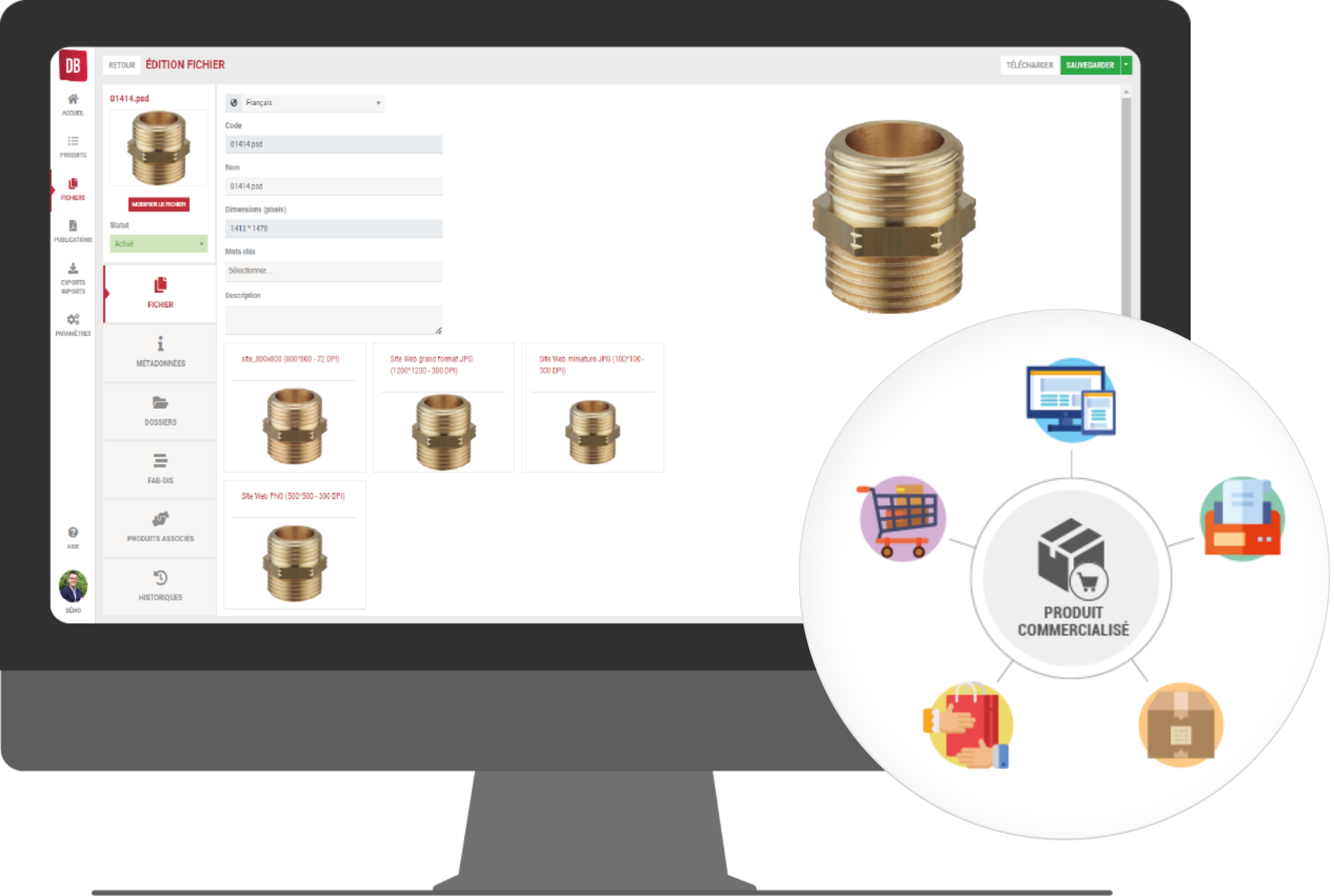

Moreover, a product evolves over time. It is often necessary to update its marketing information: increasing or decreasinf of price to follow market trends, assigning a new technical data sheet to comply with regulations, modifying visuals to make them more attractive, and so on.
This is where such an operating model quickly shows its limitations. Sales or marketing management may instruct teams to update operational data for a specific product. But teams must then apply these updates for each channel and each intermediary.
In practice, omissions or data entry errors often occur, natural consequences of manual and human intervention across multiple channels. However, a simple inconsistency of price or features can hinder purchasing decisions or damage brand credibility. And these are not the only errors that can arise in product information management. The solution is relatively simple: centralizing product data.
Why has centralizing product data become essential for marketing?
In many companies, exchanges are handled by email and phone calls. These processes rely on humans, who are fallible by nature.
It is easy for a distributor at the end of the sales chain, or even a webmaster, to miss a price correction request sent by email. This can result in potential discrepancies between the price displayed online and the one shown in a distributor’s physical store…
Similarly, you might call one of your partners who notes your request on a to-do list and eventually forgets it, overwhelmed by other urgent tasks. This reliance on unstructured processes weakens product data management.

And since human error is inevitable…
…it is also easy to forget one link in the chain. While you may think immediately of your sales director and your field teams, did you remember to notify your web agency in charge of advertising campaigns on Google or Amazon? Or your graphic designer who is preparing the printed catalog for the next trade show? A single pricing error can lead to a loss of revenue, increased human costs for urgent corrections, and a negative impact on your brand image.
It is therefore necessary to centralize your product data in the same place. A PIM (Product Information Management) software such as Interactiv’ DataBase allows you to store all essential information in a single database for every link in your marketing and sales chain.
Immediate benefits for a company:
- All your employees rely on a single and authoritative source of centralized product data. There is no longer any need for email exchanges or confirmations to verify whether information has been validated by management and correctly published everywhere it should be.
- Your marketing information is securely accessible from any computer, whether you are in the office or traveling abroad.
- All your web, print, and physical software solutions are directly connected to this PIM database and update automatically. This saves time and ensures data integrity.
- Only one update is required in your PIM. This significantly reduces the risk of errors in omnichannel distribution, making the PIM particularly effective for e-commerce.
- Fine-grained permission management for each employee or department ensures that only relevant data is displayed for each role while protecting the database from unwanted entries.
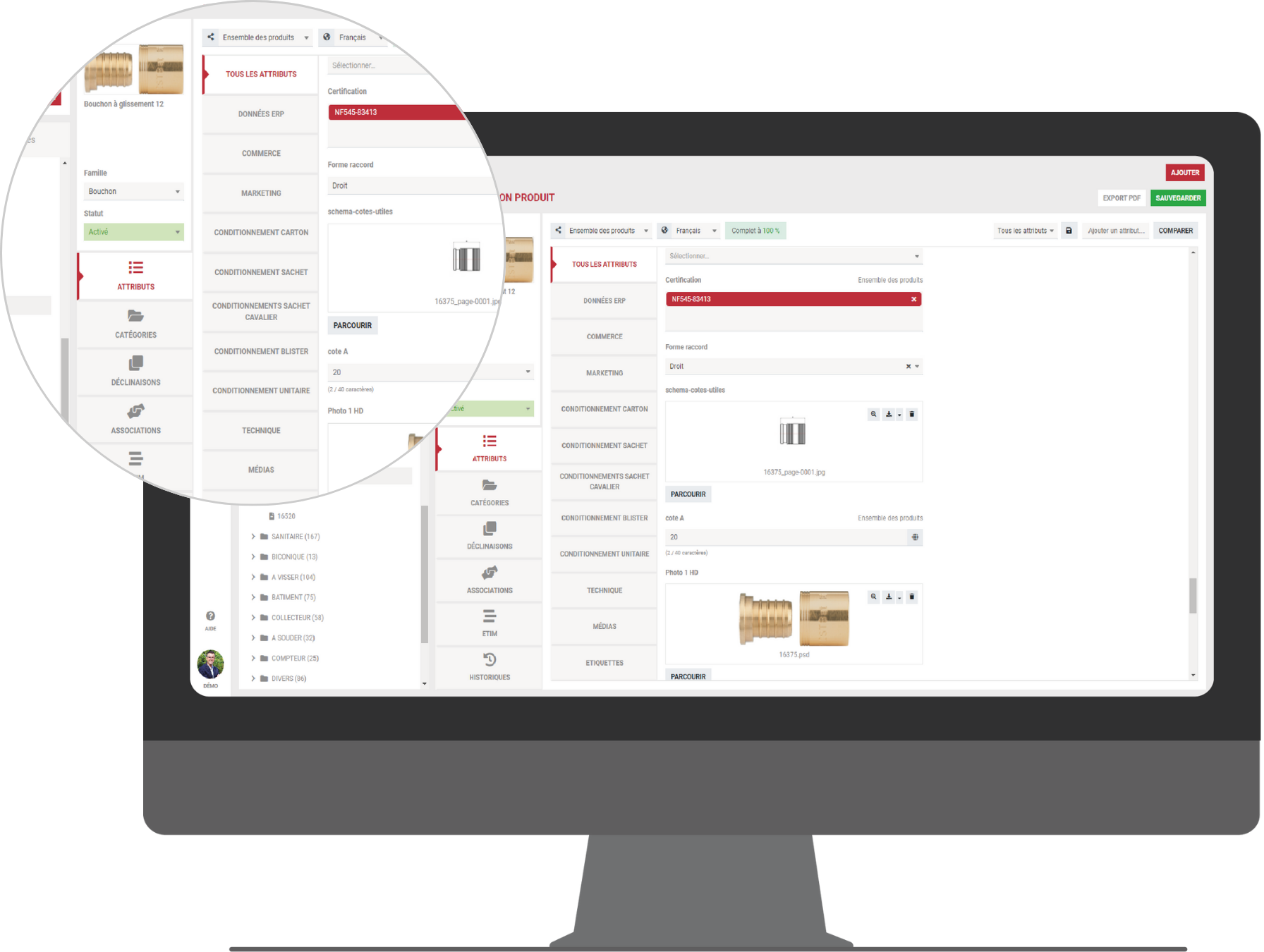
- Each product record in your PIM can contain any type of information, document, or media related to the product—all in one place. This makes it easy to find a visual, an AFNOR certification PDF, a sales argument, or a required field for your marketplace.
Why Excel is no longer adapted to marketing data management?
Many companies maintain a list of product data in an Excel spreadsheet. This solution is often chosen by default due to the lack of a dedicated tool. While it may suffice for managing a few dozen products, once the product catalog grows, this format quickly reaches its limits:
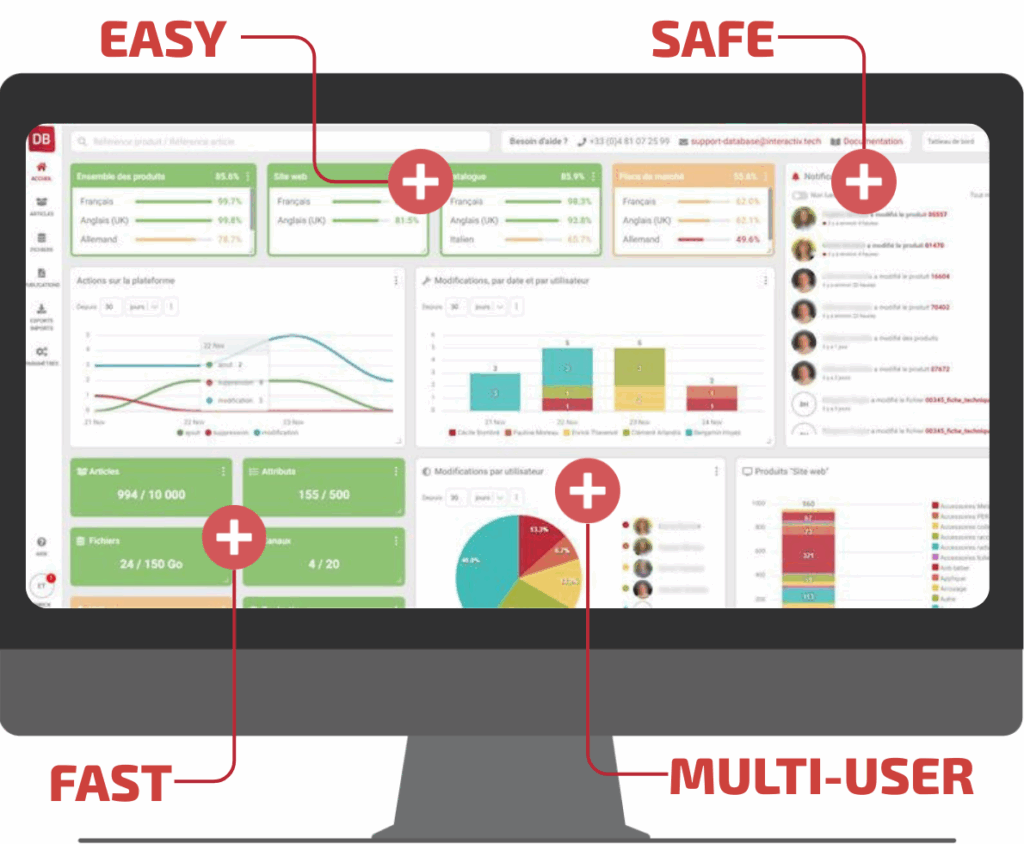
Excel file size on PCs. Opening or saving a file that can weigh several hundred megabytes severely slows down your workstation and overall productivity. A PIM solution is the ideal alternative to Excel for product data. Whether you have 50 or 5 million products, navigation and data entry remain just as smooth.
Simultaneous editing of an Excel file. You often need to ask a colleague to close an Excel file left open, which significantly slows down collaborative work. With a data management system, each user can edit marketing information at any time within the limits of their permissions.
Lack of integrity constraints and dependencies. For example, if you modify a product that depends on another, should the latter also be updated? With Excel files containing dozens of columns per product, it is easy to forget a reference or enter an incorrect one—and one error leads to another. In this context, securing relationships between marketing data is nearly impossible. In a PIM, you can define cascading update rules to ensure catalog integrity and drastically reduce errors.
Risk of data loss. A virus? A software bug? Ransomware? Have you backed up your data? Product marketing data security is a critical issue. With a 100% online PIM like Interactiv’ DataBase, this is no longer a concern: your data is secure on protected servers and backed up daily.
Key features of a PIM software adapted for marketing
A PIM is not just a database for centralizing and distributing product data. It provides intelligence and specific processing to enhance a company’s data. These features also save significant amounts of manual—and sometimes tedious—work, allowing employees to focus on higher value-added activities.

Try the Interactiv’ DataBase PIM
With the growing number of channels used to distribute product information, it is increasingly important to structure marketing product management around a PIM.
We offer a solution that is both comprehensive and accessible, adapting to the size of your company and your needs. You benefit from French-based support near Lyon, and we are attentive to evolving the solution according to your expectations.
The development of this software is the result of over ten years of collaboration with more than 1,000 clients in the field of interactive catalogs and automated layout with EasyCatalog, the world’s number one solution. We therefore have in-depth knowledge of the needs of manufacturers, e-commerce merchants, travel agencies, and many other business profiles. Product data management is part of our DNA.
Request a free, no-obligation demo and learn more about the Interactiv’ DataBase PIM by clicking below.
Any question? Contact us!
Has product marketing data management sparked your interest? Feel free to contact us by email at contact[at]interactiv.tech or by phone at +33 970 248 990.