


What is a PIM (Product Information Management) ?
The complete guide to optimize your product data
Sommaire
- What is a PIM?
- 7 advantages of a PIM software
- 3. PIM: a strategic solution for manufacturers and distributors
- Which companies can benefit from a PIM?
- Essential features of a good PIM
- How to deploy a PIM? Key steps
- What is the average implementation time for a PIM software?
- What ROI can you expect from a PIM?
- In-depth FAQ
- Learn more
Are you a manufacturer, distributor, growing brand, or marketing manager? Are you an SME, mid-market company, or large enterprise? Do you face challenges managing your product data?
Then this guide is for you!
This comprehensive article aims to:
- Clarify what a PIM software is and explain why it has become an essential tool for businesses of all sizes.
- Help you better understand the challenges that may lead a company to adopt such a tool to manage its data.
- Enable you to identify which teams and departments would benefit from this solution within your organization.
- Finally, guide you step by step in choosing, deploying, and making optimal use of a PIM software solution.
As you read through this guide, you will discover how a PIM can centralize your information, improve the quality of your product data, and optimize multi-channel distribution. Ultimately, you will gain valuable time in managing your product data, making this guide a strategic tool if you want to master your product information, reduce errors, and improve overall business performance.
1. Definition: What is a PIM?
PIM: A key tool for product management
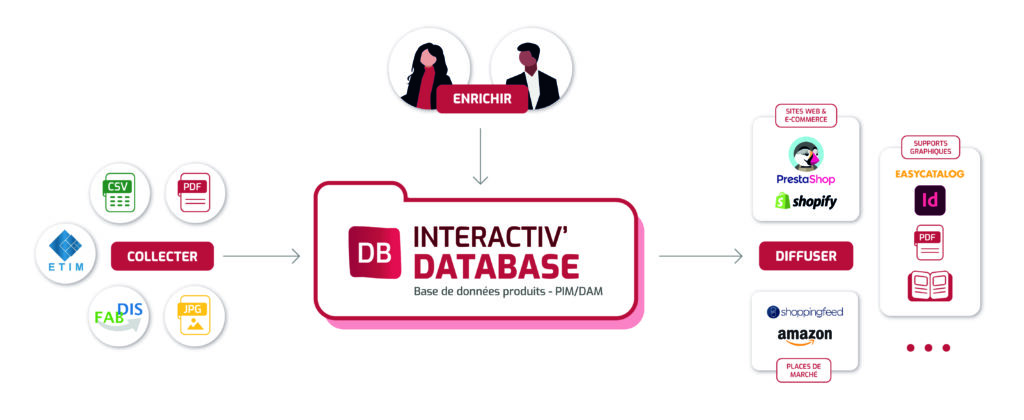
A PIM (Product Information Management) is software that allows a company to centralize, organize, and distribute its product data (technical information, marketing content, sales data, logistics data, etc.).
For example, imagine you are an SME, mid-market company, or large enterprise managing product data across multiple platforms and websites. A PIM lets you consolidate all your data into a single source, which then automatically feeds all your channels with up-to-date information.
By centralizing data through a PIM, all your product information is stored in one place and can be automatically distributed across all channels without additional manual input, ensuring significant consistency, quality, and speed.
A PIM is particularly useful if you distribute across e-commerce websites, marketplaces (like Amazon or Cdiscount), printed or PDF catalogs (via InDesign et EasyCatalog), mobile apps, or distributor and partner platforms.
In short, a PIM provides a consistent, enriched product sheet tailored to the specifications of each channel, without errors or delays.
Conclusion, a PIM is an essential tool.
With the rise of multi-channel distribution and increasing international sales, companies face managing massive amounts of often dispersed product data. A PIM allows all teams (marketing, sales, technical, production, etc.) to access a single, reliable, and always up-to-date source of product information.
What sets PIM apart from other tools?
- ERP (Enterprise Resource Planning):
- This system manages all business processes—from procurement to finance, including inventory and sales. However, ERPs are often not designed for precise and evolving product information management, especially for marketing enrichment and multi-channel distribution.
- PIM (Product Information Management):
- The PIM is specialized in this domain! Centralize, enrich, and distribute—PIMs offer multiple features to manage product data precisely, ensuring consistency, quality, and adaptability across all channels.
- Note that, most modern PIMs also integrate a DAM (Digital Asset Management) module, allowing management of images, videos, technical documents, and other media related to products within the PIM.
- DAM (Digital Asset Management):
- DAM focuses primarily on digital assets (images, videos, documents). Some DAM systems can work standalone, but today they are often integrated into PIM solutions, facilitating interoperability between data and media.
- MDM (Master Data Management) :
- MDM manages a broader scope of essential enterprise data, which may include product data. Unlike PIM, MDM covers multiple business domains.
A complete product ecosystem around PIM
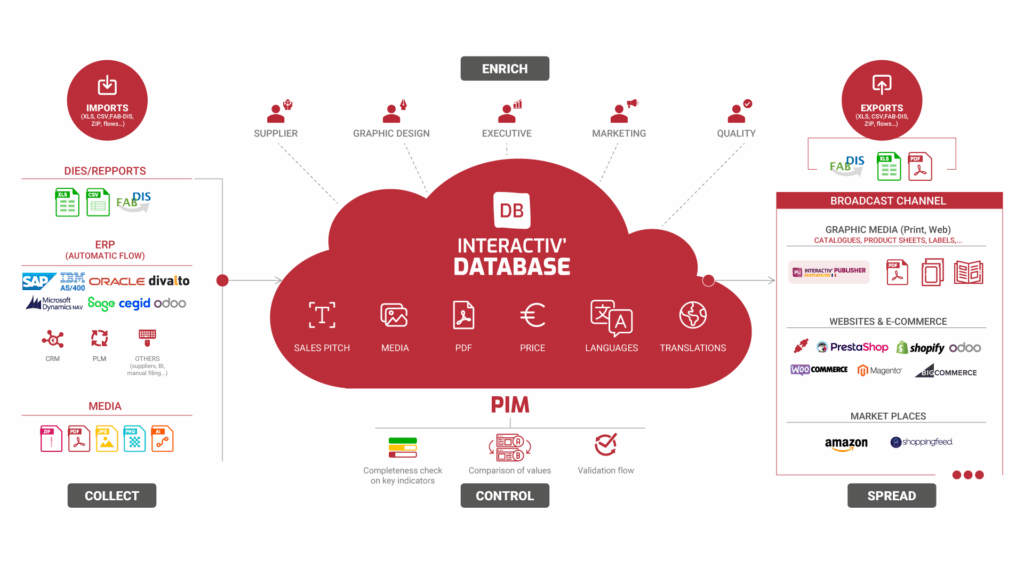
Visualize the PIM as a central hub interconnected with multiple modules and tools:
- DAM for media and document management
- ERP for operational data synchronization
- E-commerce sites and marketplaces for product sheet distribution
- Marketing and CRM tools to enhance product communication
- EasyCatalog to automate catalog, brochure, and sheet creation in InDesign
2. 7 advantages of a PIM software
A PIM (Product Information Management) software addresses multiple challenges for businesses that need to manage, structure, and distribute a large volume of product data. The PIM acts as a nerve center for product data management, intervening at every stage of the product information lifecycle and solving specific problems at each stage.
Advantage 1: centralized marketing and technical data in a single database
Problem: dispersed data from different sources
Many companies store product information across multiple sources (Excel files, ERP, marketing tools, emails, or employees’ memory). The primary function of a PIM is to consolidate marketing, technical, logistics, and sales data into a structured product database.
Sources can include:
- Excel files, ERP, internal tools,
- Suppliers via standardized formats (such as FAB-DIS, ETIM, or BMEcat),
- Different business teams with their own storage methods
In conclusion, the PIM acts as a central hub, avoiding duplicates, reducing input errors, and providing a clear, coherent view of each product sheet.
Advantage 2: structured and enriched product catalog
Problem: incomplete or inconsistent product sheets
Product sheets often lack attributes, translations, visuals… affecting brand image, e-commerce conversion, and customer satisfaction.
A SaaS PIM allows companies to create enriched catalogs, organized by logical attributes like dimensions, materials, compatibility, and applications.
A PIM/DAM integrates media management (images, PDFs, videos…), facilitating complete enrichment. Most solutions include completeness tracking tools, checking data status by channel or language.
Advantage 3: efficient multilingual and regional management
Problem: managing multilingual content
When expanding internationally, companies must account for languages and local specificities.
A PIM simplifies managing translations and multilingual content, allowing each market or country to benefit from local adaptation while maintaining a synchronized common product base.
In conclusion, companies with international or multiregional markets will benefit significantly from using a PIM.
Advantage 4: automatic distribution of product data across all channels
Problem: complexity of distribution channels
Each sales channel (e-commerce site, distributor, marketplace, print catalog, etc.) has unique format, content, and update frequency requirements.
A SaaS PIM allows automatic distribution of product information to all connected channels:
- Print catalogs
- E-commerce sites (Magento, PrestaShop, Shopify, etc.)
- Marketplaces (Amazon, ManoMano, etc.)
- Distributor platforms (via FAB-DIS, BMEcat, API, Excel files)
Data are exported in the appropriate format, at the right frequency, considering channel-specific requirements.
Advantage 5: always up-to-date data optimized for SEO
Problem: slow updates and error-prone processes
Manual updates across multiple platforms are time-consuming, repetitive, and prone to errors. Manual data entry, tedious modifications, inconsistencies, and missing information can quickly impact data quality and slow down time-to-market.
A product data management solution ensures a product database that is constantly synchronized with internal sources such as ERP systems, supplier files, or CRM tools. As a result, every update is automatically applied across all sales channels. Manual data entry, repetitive updates, errors, and omissions become a thing of the past. From pricing information to technical datasheets, every piece of data is automatically integrated and kept up to date.
However, a robust PIM goes beyond ensuring data accuracy. It also plays a key role in optimizing content for SEO. By centralizing all product-related content within a single platform, companies can harmonize meta titles, meta descriptions, and product descriptions, while consistently enriching texts with relevant keywords across all channels.
As a result, product content becomes better structured, more consistent, and more effectively indexed by search engines, including AI-powered search systems and conversational assistants such as ChatGPT, Gemini, and Perplexity.
Let’s take the example of a lighting manufacturer…
He uses a PIM DAM solution to manage its product catalog. Each product page includes an SEO-optimized title, a keyword-rich description (highlighting lamp type, style, materials, etc.), high-definition images, and an automatically generated URL.
Thanks to centralized product data management within the PIM, the company’s three European e-commerce websites are constantly up to date, well indexed, and well positioned in Google Search results for queries such as “brass wall light for living room.”
Ultimately, the lighting manufacturer saw a 42% increase in organic traffic to its product pages within six months.
Advantage 6: more structured data collaboration
Problem: lack of collaboration between departments
It is common to observe a lack of collaboration between marketing, product, sales, and technical departments, which often work in isolation. The result is a slowdown in the process of creating and updating data.
A SaaS PIM software also helps strengthen collaboration between marketing, product, sales, and management teams through:
- precise management of roles and access rights,
- clear validation processes for product sheets,
- implementation of task and enrichment tracking,
- complete traceability of actions.
Product data management thus becomes a structured and efficient team effort, serving overall performance.
Advantage 7: Facilitate exchanges with suppliers
Problem: supplier information is difficult to obtain
Distributors and resellers must gather product data from dozens or even hundreds of suppliers, each of whom has their own format requirements (Excel, PDF, emails, etc.) and rules.
A PIM allows importing, normalizing, and automatically structuring supplier data. Regardless of the original format (FAB-DIS, ETIM, Excel, etc.), the PIM provides it while facilitating continuous updates.
3. PIM: a strategic solution for manufacturers and distributors



Manufacturers and distributors generally manage very complex product catalogs and therefore have high requirements for content accuracy, regular product information updates, and distribution across sales channels. Given these numerous constraints, a product information management solution becomes essential to optimize product data management and improve commercial performance.
Specific challenges for manufacturers and distributors
As mentioned above, manufacturers must manage precise technical data daily (such as dimensions, materials, standards, certifications…), and this data is constantly evolving. Distributors, on the other hand, face multiple catalogs from various suppliers, each with its own format, complicating their task.
For both actors, centralization, quality, and consistency of product data are crucial for several reasons:
- reducing potential errors,
- limiting product returns from customers,
- ensuring regulatory compliance,
- providing a smooth and logical experience,
- efficiently managing information updates (like price or stock changes),
- and accelerating time-to-market.
The PIM addresses these challenges by centralizing product data, ensuring regular and automatic updates across all channels, and enabling dissemination in standardized formats.
Marketing and technical management of product data
A PIM platform allows simultaneous management of technical data (such as specifications, standards, features…), marketing data (from descriptions to visuals and promotional arguments…), and commercial data (pricing, terms, promotions…).
Thus, it is an indispensable tool for manufacturers and distributors because it ensures that technical and marketing teams have access to the same product data and can work daily with shared, up-to-date information. This improves collaboration, message consistency, and responsiveness to customer demands.
Focus on FAB-DIS: a key standard for FAB-DIS
FAB-DIS, a French and European standard, facilitates data exchanges between manufacturers and distributors, mainly in the construction sector but also in other domains (sanitary, electrical, and other technical industries). Its goal is to standardize product files to simplify these exchanges.
However, it is important to note that not all PIM software is equivalent regarding the FAB-DIS standard. This is due to two factors:
- Many software solutions export files in “FAB-DIS format,”
- But only some are officially validated and labeled FAB-DIS Inside.
Certification legally guarantees that the software generates compliant files that distributors can use directly, without data loss or errors.
Interactiv’ DataBase is among the few PIM software solutions certified FAB-DIS Inside, providing a reliable and recognized solution to automate and secure these essential exchanges.
Concrete example: an electrical equipment manufacturer exporting its catalog
A European manufacturer of industrial electrical equipment manages over 20,000 references, each with a complex technical sheet requiring frequent updates. Their product catalog must be distributed to hundreds of distributors and online sales platforms.
By implementing a FAB-DIS Inside certified PIM DAM tool, this manufacturer ensured:
- centralization of all technical and marketing data in a single database,
- automatic generation of FAB-DIS files, validated and sent to distributors without manual adjustments,
- a two-thirds reduction in time spent updating catalogs,
- indirect improvement in customer satisfaction and reduced ordering errors thanks to higher-quality product sheets.
4. Which companies can benefit from a PIM?
Many organizations view product data management solutions as a key tool when they need to efficiently manage their product data, particularly in complex multichannel environments. The purpose of a PIM is to centralize, enrich, and distribute data from a single product database, regardless of the sector or size of the company.
Industrial SMEs
Industrial SMEs often face complex technical catalogs and strict regulations. They benefit greatly from a PIM platform, which allows them to:
- organize technical and marketing data,
- ensure regular information updates,
- automate distribution to distributors, websites, and sales materials.
Let’s take the concrete example of an industrial SME
This company, specialized in mechanical equipment manufacturing, struggled with multiple dispersed sources (Excel files, ERP…) and had no single database to manage product data such as pricing and technical documents.
By adopting a PIM DAM solution, the SME successfully centralized all product information in a single reliable source, automated updates on websites and printed catalogs, and simplified price management.
This centralization allowed them to update all prices with a few clicks, ensuring commercial information was always up-to-date internally and across all sales channels. Consequently, they avoided costly errors and improved responsiveness to market fluctuations.
Ultimately, they experienced significant time savings, reduced errors, better compliance of technical sheets, and simplified pricing management.
Trading and distribution companies
Distributors or wholesalers often manage a large number of references from multiple suppliers in various formats.
With a PIM DAM platform, they can:
- centralize and standardize product data,
- faciliter la diffusion sur vos marketplaces, vos catalogues et tout autre support marketing,
- alimenter plus facilement vos sites e-commerce et tous vos outils de vente.
COMATEC: a PIM project to structure and distribute multichannel product data
COMATEC, a French manufacturer of premium packaging for the foodservice industry, implemented the Interactiv’ DataBase PIM/DAM solution to centralize and structure its 1,500 product references within a single data source.
The PIM was connected to the EasyCatalog plugin to automate print catalog production and to PrestaShop via a connector to feed the e-commerce website.
Thanks to the PIM solution, COMATEC achieved a consistent and harmonized distribution of product data across all channels. As a result, they observed:
- Production lead times divided by three,
- Elimination of manual data re-entry,
- Improved data quality,
- Long-term autonomy for marketing teams
Multichannel growing brands
A rapidly expanding brand across multiple sales channels generally needs a reliable product database to ensure catalog consistency and quality for customers across a growing number of channels.
A SaaS PIM software solution helps daily by enabling:
- synchronization of product information between physical stores, e-commerce sites, marketplaces, and marketing materials,
- distribution of up-to-date, consistent content,
- and maintaining a strong brand image overall.
Marketing, product, and e-commerce teams
Collaboration challenges between teams are well-known. A PIM ensures marketing, product, e-commerce, and sales teams work on the same, reliable, and up-to-date product database instead of relying on multiple departmental files.
The resulting benefits include:
- creation of SEO-optimized content,
- management of updates,
- coordination across departments,
- rapid distribution across all channels.
Multilingual brands: managing translations easily
As mentioned earlier, a PIM is strategic for brands expanding internationally by simplifying product sheet translations into multiple languages, optimizing translated content, and allowing filtering of multilingual content on the appropriate channels. This facilitates global, multichannel product data management and gives companies a comprehensive overview.
For example, let’s take the example of an internationally expanding textile brand
Using our PIM solution with advanced multilingual management features, the brand centralized translations, automated distribution across local and international channels, adapted content to markets, and ensured rapid updates with optimal consistency.
Conclusion: The company achieved better consistency of product information, rapid updates, SEO optimization for each market, and reduced product sheet errors by 50%.
5. Essential features of a good PIM
An effective SaaS PIM software must offer key functionalities to ensure optimal product data management, allowing centralization, enrichment, and distribution in a multichannel catalog.
Enriched product sheets
One primary feature is the creation of complete, detailed product sheets, integrating technical data, marketing descriptions, visuals, videos… This richness enhances the customer experience and improves SEO.
Management of variants, families, and attributes
A good PIM structures products into families and subfamilies while easily managing variants (sizes, colors, models…). Attribute management ensures sheet accuracy and customization.
DAM integration: images, technical documents, manuals
Companies often possess numerous media to enrich content (HD images, technical documents, certifications..). It is difficult to find the right file when this media is scattered. An integrated DAM module centralizes these media, reducing errors, simplifying updates, and ensuring visual/document consistency.
Translations and multilingual management
For international companies, a PIM facilitates global/multilingual content distribution by:
- organizing content by language and market,
- managing translations,
- ensuring global consistency,
- overseeing collaborative validation and updates.
Export of custom matrices (Excel, PDF, FAB-DIS…)
Exporting custom matrices (Excel, PDF, FAB-DIS…) is essential for product data management. An efficient product information management software enables to create tailored files for internal or partners needs, for example :
- Excel for sales teams,
- PDF catalogs for communication,
- Standardized FAB-DIS files for distributors.
E-commerce / Marketplace / ERP connectors
A robust PIM SaaS offers native or customizable connectors to synchronize product data with e-commerce platforms, marketplaces, ERPs, and other systems for smooth real-time dissemination.
Data quality verification
Data quality verification is crucial. A quality PIM includes automated tools ensuring completeness, consistency, and compliance. It detects:
- missing/incomplete data,
- formatting or typographical errors,
- inconsistencies between attributes or product families,
- non-compliance with internal rules or external standards.
These controls ensure a reliable database and build trust with clients and partners.
AI features: automation and optimization
Modern PIM solutions increasingly incorporate AI features, allowing:
- automatic enrichment of product descriptions optimized for SEO,
- detection and correction of errors or inconsistencies,
- intelligent suggestions for categories, attributes, or images,
- predictive analysis for stock management and marketing needs,
- automation and quality control of multilingual translations.
These AI tools significantly improve product data quality and consistency, reducing team workload.
Concrete example: multichannel manufacturer
An electronics manufacturer uses product data management software with an integrated PIM DAM module to manage over 50,000 references. Advanced features enable:
- enriched product sheets with videos and technical manuals,
- precise variant management per market,
- translation into 10 languages,
- automatic FAB-DIS file export to European distributors,
- continuous synchronization with ERP and e-commerce site.
This improved productivity, reduced dissemination errors, and enhanced client and partner satisfaction.
6. How to deploy a PIM? Key steps
Deploying a SaaS PIM is a strategic process requiring rigor and method. Key steps ensure optimal data management and successful adoption.
Choosing your provider: software vendor or integrator?
When selecting a PIM solution, companies often hesitate between choosing a software vendor offering a ready-to-use solution developed in-house, and an integrator responsible for implementing an existing solution.
The software vendor provides a turnkey platform, regularly updated, with generally controlled timelines and costs.
The integrator, on the other hand, focuses on adapting and customizing a PIM solution to fit a specific IT environment.
This choice mainly depends on the size of the company, the complexity of product data, internal resources, and budget.
SMEs often favor directly published SaaS solutions, while more complex organizations may opt for custom-integrated projects. There are also PIM vendor-integrators, such as Interactiv’ Technologies, which combine both areas of expertise. This hybrid positioning enables them to deliver both a robust software solution and an integration tailored to specific needs, thanks to their in-depth knowledge of the tool. Choosing this type of provider helps optimize deployment costs and streamline collaboration with the vendor.
Initial audit (or kickoff meeting)
Before implementing any software, you need to set up a complete audit of existing product data and business needs. It identifies :
- data product sources,
- formats in use,
- potential duplicates or gaps,
- current departmental data management processes.
In short, the final audit is essential to define an appropriate strategy.
Data cleaning
To ensure project success, it is necessary to clean data to achieve high-quality final data. This step corrects errors, removes duplicates, harmonizes formats, and fills missing information in the product database.
Proper data cleaning facilitates modeling (the next step) and avoids future quality/coherence issues.
Reference modeling
This step structures product data according to families, categories, attributes, and business rules specific to your company.
Finally, custom modeling while deploying a PIM ensures clear product catalog organization and simplifies variant management and multichannel distribution.
Import
Once the reference model is ready, cleaned and modeled data is imported into the PIM database. But it is important to do it carefully. It may be done via connectors or adapted import/export tools so that the product database is fully and completely integrated.
Testing
After the well integration of your product data, test the PIM to ensure it meets needs, assessing data quality, workflows, validation rules, and distribution to channels (websites, marketplaces, print catalogs).
This phase corrects anomalies and adjusts settings.
Production deployment
After doing validated testing, the PIM goes live. Teams manage, enrich, and distribute product data from a centralized, reliable, and scalable platform.
Training
Project success relies heavily on team adoption. We advise you to provide adapted training to each department: marketing, product, e-commerce, and other departments. This training cover :
- PIM system usage,
- product data management,
- reference organization,
- SEO best practices,
- internal processes.
Training boosts skills, maximizes efficiency, and ensures optimal software use.
Continuous improvement
PIM SaaS deployment is an ongoing process.
It is advised to:
- analyze performance,
- collect user feedback,
- adjust processes,
- optimize data quality,
- evolve structure based on new needs.
This continuous improvement maximizes ROI and ensures long-term PIM relevance.
7. What is the average implementation time for a PIM software?
Several criteria must be considered when evaluating the implementation time of a SaaS PIM software: company size, product data complexity, desired features, and more. It is essential to understand these factors when planning a PIM implementation.
Factors influencing implementation time
Many factors can impact the time required to deploy your PIM solution:
- the volume and initial quality of the data that must be cleaned and imported,
- the complexity of the company’s data model (families, attributes, variants, etc.),
- required integrations with your ERP, e-commerce platforms, or marketplaces,
- available internal resources,
- the level of customization required for your centralized product reference model.
Average duration by company size
- For SMEs: implementation generally takes between 4 and 8 months for a full PIM deployment, including all stages from data cleaning to production, modeling, import, testing, and training.
- For mid-sized companies and large enterprises: implementation typically ranges from 6 to 12 months, and sometimes longer. This is due to increased complexity of product catalogs, multiple sales channels, and advanced technical integrations.
Agile and iterative methodology
We recommend adopting an agile approach if you wish to reduce implementation timelines:
- Step 1: deploy a minimum viable version as soon as possible,
- Step 2: progressively enrich your database and available features,
- Step 3: continuously adjust the PIM based on team feedback and business needs.
This method is recognized for ensuring the success of PIM projects. It allows you to implement an optimized PIM that facilitates data centralization and management while delivering fast and tangible results.
8. What ROI can you expect from a PIM?
Investing in a PIM platform is often a strategic decision for companies aiming to improve product data management, centralize marketing information, and ultimately enhance commercial performance.
Given the changes involved in implementing a product data management solution and the associated costs, it is natural to question the return on investment (ROI) that can realistically be expected from a PIM.
Time savings
By automating the collection, updating, and distribution of product data across all sales channels, a SaaS PIM software significantly reduces the time teams spend on tedious and repetitive tasks.
As a result, marketing and product teams spend less time searching for, correcting, and duplicating product information, allowing them to focus on higher value-added activities.
Improved product data quality
By centralizing product data within a PIM DAM, you ensure that distributed information is up to date, consistent across all channels, and enriched with a variety of elements (images, technical documents, descriptions, etc.).
As a result, high-quality product data minimizes potential errors, reduces product returns caused by inaccurate information, and overall improves customer satisfaction.
Increased commercial performance
By using a PIM to optimally manage product catalogs and rapidly distribute reliable data, companies observe improved visibility across sales channels, an increase in the number of products published online, and higher conversion rates.
By enabling content adaptation per channel, a PIM improves search engine optimization (SEO), website traffic, and lead generation. Thanks to fast and reliable data distribution via the PIM, companies experience better channel visibility, faster time-to-market, and increased conversions.
Concrete example: ROI measured at a multichannel distributor
An electronic equipment distributor implemented a PIM solution. After 12 months, the company observed:
- a 40% reduction in time spent managing product data,
- a significant decrease in potential errors within product catalogs thanks to the integrated DAM module,
- a 15% increase in revenue generated from its e-commerce platforms due to better product information quality and distribution.
Through this example, we can see how a PIM can transform product data management into a true competitive advantage.
9. In-depth FAQ
Below you will find our detailed FAQ. It is designed to answer frequently asked questions and help you better understand the capabilities and advantages of a product data management solution, particularly in terms of product data management and marketing information centralization.
Key differences compared to other solutions
What is the difference between Interactiv’ DataBase and other PIM solutions?
Interactiv’ DataBase stands out through its all-in-one approach, integrating PIM/DAM, import/export modules, and publishing features. Its SaaS deployment model is simpler, as it does not require an external integrator. In addition, Interactiv’ Technologies provides unlimited expert support. This makes the solution particularly well-suited for SMEs, offering efficient and tailored product data management.
Product capacity
How many products can be managed with a PIM software?
In general, modern SaaS PIM solutions such as Interactiv’ DataBase can handle very large databases, ranging from several hundred to several thousand product references, while ensuring smooth scalability.
AI features
What artificial intelligence features are available in a PIM?
A PIM integrates multiple AI-powered features, such as:
- automatic enrichment of product sheets,
- suggestions for SEO-optimized product titles and descriptions,
- identification of inconsistencies in product data to improve overall quality.
ERP compatibility
Is a PIM compatible with existing ERP systems?
Yes, Interactiv’ DataBase is compatible with the leading ERP systems on the market through connectors that enable seamless integration. This ensures synchronized product data, pricing, and inventory across systems.
Export formats
Which export formats are supported in the PIM?
A high-quality product information management software supports numerous formats for exporting customized matrices in Excel, PDF, FAB-DIS (for certified manufacturers and distributors), and more. This facilitates multichannel distribution and secure data exchange.
Multilingual management
Is it possible to manage multiple languages with a PIM?
Yes, most modern PIM solutions include multilingual management. You can translate, adapt, and distribute product sheets in multiple languages, optimizing international presence and local SEO.
Technical compatibility
What technical prerequisites are required to use a SaaS PIM software solution?
SaaS PIM solutions like Interactiv’ DataBase require minimal technical prerequisites. They are accessible directly via a web browser (no local installation), compatible with major operating systems (Windows, macOS, Linux, etc.), and usable with a standard internet connection.
10. Learn more
Interactiv’ DataBase is a SaaS PIM solution developed by Interactiv’ Technologies, primarily designed for SMEs across various sectors (industry, distribution, e-commerce).
Deployed to more than 1,000 users, it combines Product Information Management (PIM), Digital Asset Management (DAM), and multichannel exports, with direct deployment by the software vendor and no external integrator required.
Would you like more information about our Interactiv’ DataBase PIM and DAM software? Feel free to contact us by email at contact[at]interactiv.tech or by phone at +33 (0)9 70 24 89 90.